
For manufacturers, growth doesn’t always come from expanding demand; it comes from taking share. One common tactic, or not-so-common tactic, from what we hear, does exactly that: a competitor bounty program.
You’ve likely seen versions of this before, even if they weren’t labeled as such: a manufacturer offers a financial incentive to distributors, contractors, or dealers for switching from a competitor’s product to their own equivalent or better solution.
This article explains what a competitor bounty program is, where it’s most effective, when to use it, and how to incorporate it thoughtfully into a wider manufacturing marketing strategy.
3 Key Takeaways
- Competitor bounties reward switching, not spending. Unlike usual rebates or SPIFFs, these programs are designed to change buying behavior. When structured correctly, they give manufacturers a controlled, measurable way to win market share from specific competitors.
- They work best as an entry point, not a standalone strategy. The most effective competitor bounty programs are paired with volume rebates, loyalty incentives, or training programs that retain new buyers long after the initial switch occurs.
- Operational discipline determines success. Clear eligibility rules, simple proof requirements, and reliable validation and payout processes are what separate scalable bounty programs from costly, short-lived promotions.
What Is a Competitor Bounty Program?
A competitor bounty program is a targeted incentive designed to motivate buyers to stop purchasing Brand A and begin purchasing Brand B.
Unlike traditional rebates, we are accustomed to seeing that reward volume or loyalty, competitor bounties reward behavioral change.
Typical program mechanics include:
- Proof of prior purchase from a named competitor, such as recent invoices, distributor statements, purchase histories, serial numbers, or job documentation that clearly shows the competitor brand, product type, and purchase timeframe. The goal is to verify a legitimate switch without creating unnecessary friction for the participant.
- A defined switch window (e.g., 60–120 days), which establishes urgency, limits retroactive claims, and protects the program from abuse. This window clearly defines when a participant must stop purchasing the competitor’s product and begin purchasing yours, ensuring the incentive rewards a true behavioral shift rather than historical buying activity.
- Incentives are paid per unit, per order, or as a percentage rebate, each serving a different strategic purpose. Per‑unit bounties work well when manufacturers want to drive adoption of a specific SKU or product line and keep payouts predictable. Per‑order incentives encourage larger initial commitments and simplify validation. Percentage‑based rebates scale with deal size and are often better suited for higher‑ticket or premium products, where manufacturers want the reward to match revenue impact rather than unit count.
- Eligibility is limited to comparable or premium replacement products, which protects brand positioning and prevents the program from devolving into a price‑driven race to the bottom. By restricting bounties to products that meet or exceed the competitor’s performance, specifications, or warranty standards, manufacturers reinforce the message that the incentive rewards smart switching rather than cheaper substitutions. This also helps sales teams defend margin, supports distributor alignment, and attracts higher‑value customers who are more likely to remain loyal after the initial switch.
In simple terms: “Show us you switched, and we’ll pay you for it.”
That simplicity is exactly why competitor bounty programs are so effective—but also why they need to be used in the right places. These incentives don’t work equally well across all markets or channels. Their impact is heavily influenced by buying behavior, competitive forces, and the extent of manufacturers’ influence over the decision-making process.
Where Competitor Bounty Programs Are Most Common
Competitor bounty programs show up most often in industries where:
- Products are functionally comparable.
- Brand loyalty exists, but it isn’t absolute.
- Switching costs are manageable.
- Distribution relationships matter
Common use cases include:
- Building materials and construction products
- Automotive OEM and aftermarket parts
- Industrial equipment and components
- Technology hardware and SaaS migrations
- Foodservice and packaging manufacturers
What all of these industries share is a common reality: buyers rarely switch brands without a convincing reason, and frankly, why consumer incentive programs are so important. Even when products are comparable, inertia, perceived risk, and existing relationships slow decision‑making; that’s where competitor bounty programs move from theory into practice—by giving buyers a clear, justified reason to act.
Real‑World Example: Trade‑In Incentives as a Competitor Bounty
One of the clearest real‑world parallels to a competitor bounty program can be found in trade‑in and trade‑up incentive programs, particularly in technology, automotive, and equipment markets.
For years, major technology manufacturers and service providers have offered financial credits to customers who trade in an existing competitor device when purchasing a new one. The mechanics are simple: the buyer proves ownership of a competitor’s product, completes the switch within a defined time frame, and receives a credit, rebate, or a reduction in the bill for the new purchase.
While these programs are rarely labeled as “competitor bounties,” they function the same way:
- The incentive is contingent on proof of competitor usage.
- The reward is tied directly to switching behavior, not loyalty or volume.
- The program reduces switching costs and perceived risk.
Manufacturers in B2B and industrial markets adapt this same concept without requiring physical product trade‑ins. Instead of surrendering hardware, participants submit invoices, job documentation, or distributor purchase histories that show prior spending with a named competitor. Once validated, the manufacturer issues a defined bounty for switching to its product line.
The lesson for manufacturers is clear: competitor bounty programs work best when they remove friction, acknowledge the buyer’s existing investment in a competitor brand, and reward firm action, not when they attempt to win business through blanket discounts.
When Should a Manufacturer Consider a Competitor Bounty?
Not every manufacturer should deploy a competitor bounty. These programs are most effective when used intentionally rather than reactively.
Consider a competitor bounty when:
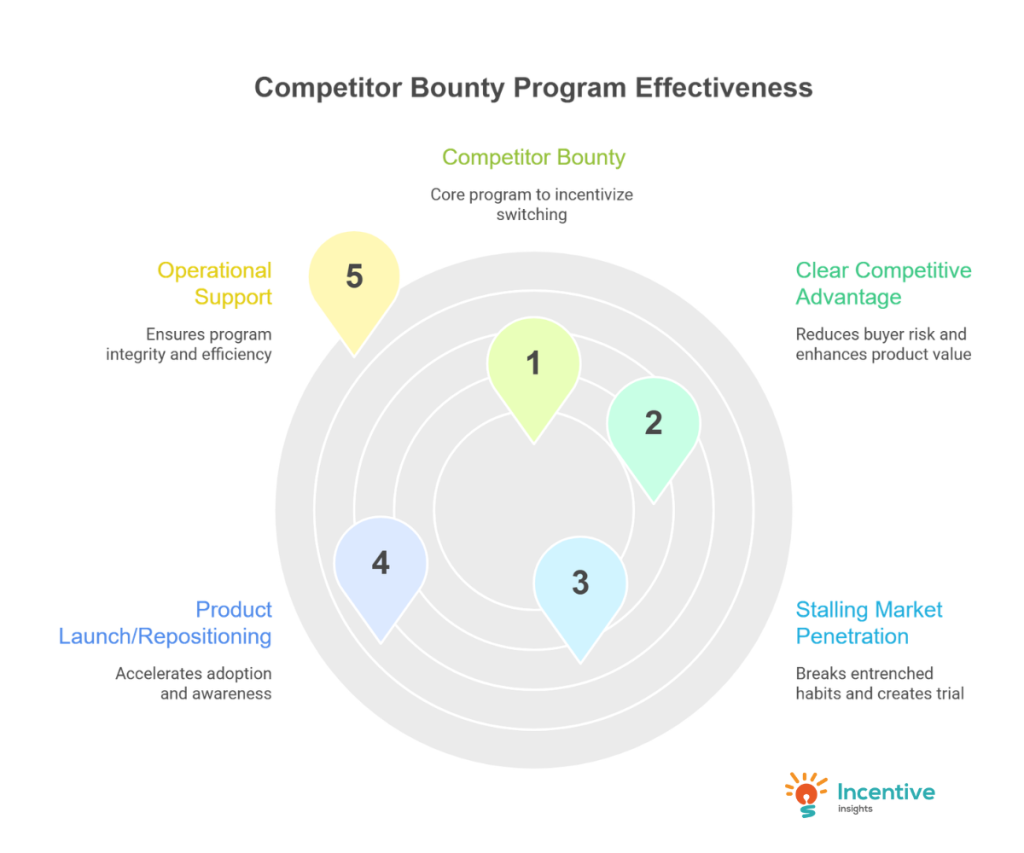
- You Have a Clear Competitive Advantage: If your product is truly comparable—or superior—you’re reducing the buyer’s perceived risk. Incentives work best when they nudge, not when they bribe.
- Market Penetration Is Stalling: If growth has plateaued despite demand, a bounty program can break entrenched buying habits and create new trial opportunities.
- You’re Launching or Repositioning a Product Line: Competitor bounties are powerful launch accelerators, especially when paired with education, training, or temporary multipliers.
- You Can Support the Operational Lift: Switch incentives require validation, tracking, and auditing. If the backend isn’t ready, the program will struggle.
How Competitor Bounties Fit Into a Manufacturing Marketing Plan
A competitor bounty should never exist in isolation. It works best as one tool within a layered incentive-and-demand strategy.
Strategic Role
- Top-of-funnel conversion driver: Encourages first-time trial
- Sales enablement tool: Gives reps a solid switching argument
- Data capture mechanism: Reveals competitive brand usage
Tactical Pairings
Competitor bounty programs are most effective when paired with:
- Volume-based rebates (to retain new buyers)
- Training or certification incentives
- Distributor-specific SPIFF sales incentive
- Time-bound accelerators
This turns a one-time switch into a long-term relationship.
Designing a Smart Competitor Bounty Program
A successful program balances simplicity for participants with rigor behind the scenes.
Key considerations:
- Clear definitions of eligible competitor products
- Straightforward proof requirements
- Transparent payout rules
- Defined caps or thresholds to control liability
- Fast, reliable fulfillment
From an operational standpoint, manufacturers should plan for:
- Submission workflows (portal, upload, distributor feeds)
- Validation logic
- Audit trails
- Reporting by competitor, product, and channel
If you need some help, Incentive Insight’s marketing team can help you build a smart competitor bounty program
Risks and Pitfalls to Avoid
Like any incentive strategy, competitor bounties carry risk if poorly designed, making them a top marketing mistake.
Common mistakes include:
- Incentivizing price shoppers with no retention plan
- Overcomplicated rules that confuse participants
- Underestimating admin and data requirements
- Triggering channel conflict with distributors
Final Thoughts: Incentives as Strategy, Not Discounts
At their best, competitor bounty programs are not about buying business but about earning it
They reward action, surface valuable market intelligence, and create opportunities for long-term loyalty when paired with the right rebate and engagement strategy.
When carefully designed and professionally managed, competitor bounties become a powerful component of a modern manufacturing marketing plan, one that values relationships, data, and lasting growth over short-term wins.
If you need help creating a plan, please let us know and book some time here. We can also provide marketing consultancy to help tie bounty programs into your other incentives.

Nathaniel Smathers, a contributor to the Incentive Insights blog, brings a fresh perspective on business strategies and market trends. With a background in marketing and a passion for data-driven insights, Nathaniel offers a unique blend of expertise and creativity. His approach to dissecting complex market dynamics and transforming them into actionable strategies makes him an invaluable asset to our team.