andexcellentMarketing and growing your business is not a one-size-fits-all approach. There is no silver bullet that solves all your outreach questions or targets every one of your unique markets. Instead, you need to cultivate several marketing tools to better connect with your ideal consumer. The fact of the matter is that not every customer will be attracted by every marketing approach. Some might only find their way to your sales doorstep via discounts, while others strictly rely on word of mouth from friends, family, or business associates who have purchased from you. And yet, some will connect with the idea of a rebate. Rebates offer benefits that no other marketing or outreach approach can match. It is well worth your time and energy to work with a service provider that specializes in rebate programs and marketing.
However, before you begin, it is a good idea to gain a better understanding of the general pros and cons of rebates and how they can affect your company’s overall success.
Benefits of Various Rebate Programs
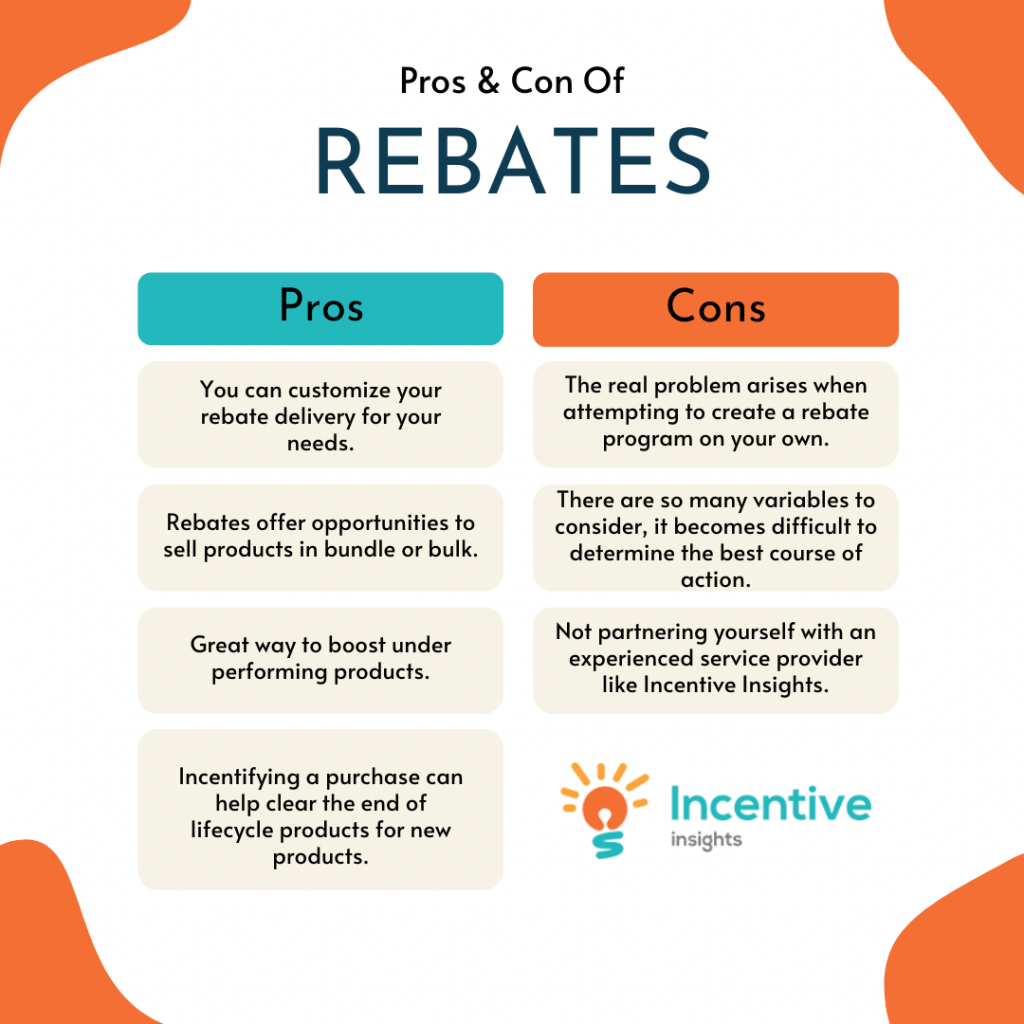
One of the significant benefits of rebate programs is your ability to customize how you deliver the rebates to buyers. You can implement a single rebate program for all your customers, or you can offer a range of programs to fit better the individual demographics that shop with your business.
Some behaviors you can use with your customers include buying in multiples, buying bundled, buying products from a specific retailer, or offering benefits through social media platforms.
When offering a rebate based on buying multiples, you will incentivize the purchase of multiple products at the same time. This is a relatively common incentive when the cost per item is low or when a large amount of inventory needs to be moved. It might be as simple as buy two, get one free. Or you might offer a percentage discount if the customer buys two of the same product. There are various methods for implementing this kind of rebate, which is one of the major benefits of such a program. There is limitless potential in this kind of setup.
A similar option is known as buying a bundle. Instead of purchasing several of the same products, a customer must buy various products at the same time to receive the rebate. This is often seen in the tech world, where a customer needs to purchase the latest smartphone, smart watch, and headphones at the same time. If they do, they will receive an added discount, the watch for free, or a special rebate to be used with the tech provider. Like buying in multiples, buying bundled items together helps promote the purchase of certain products and increase sales for specific items that might, on their own, not see the same sales volume without the bundle. Customers might not consider buying a drawing pen with their tablet, but if there is a special incentive discount attached to purchasing the two together, it will likely increase the sales of these pens.
If you do not sell your products directly but instead sell through retail outlets, you can consult with your retail partners to orchestrate location-specific rebates again, when focusing on rebates for the high-tech industry, one particular wireless service provider might offer a special discount on a smartphone should a customer sign-up with that wireless provider. They might offer the smartphone for less than through other providers. Naturally, this is not tech-specific (although technology firms do take advantage of this because their products are often more expensive up-front purchases). It doesn’t matter if you sell pancake mix, clothing, or bathroom hygiene products; you can partner with retail partners to offer specific rebates.
One benefit you might not consider out of the gate is something that isn’t revenue-related. Sometimes it’s more about increasing your social foothold. Having a strong social media following can prove incredibly beneficial for your business. It lets you effortlessly market to customers in the future. Plus, with the amount of user data you can obtain via platforms like Facebook, you can customize advertisements for these customers moving forward. With these kinds of rebate programs, you will offer special discounts or even free content in exchange for them doing something specific on your social profile. You might offer a rebate coupon code or access to a new product if, in return, the social media user follows your page, likes a post, and shares it with their own following. By requesting that they share your post, you place your advertisement directly in front of hundreds (if not thousands) of additional shoppers. Often, this can be more financially beneficial for your business than buying ad space on Facebook flat-out.
The Benefits Of Boosting Underperforming Products
Not all products will sell as expected. For one reason or another, many products will not connect with consumers the way you would have liked. That doesn’t mean you’re not offering quality material to your customers, though. You just need to find a different way to boost these underperforming products.
Using rebates is an excellent way to do exactly this. You can attach rebates specifically to these underperforming products, or you can bundle them with other higher-selling products, as mentioned in the section above. You can even target underperforming products in given sales regions. Perhaps you sell soft drinks, and while the soft drink is selling well in one market, it’s falling flat in another. By offering rebates in the new market, or by giving customers the ability to try out your new product by giving it away for free (after they buy two of a more popular product) then you can eventually boost sales of the given product that is struggling.
This method works not only with territories but also with retail chains. Often, different demographics purchase products at different retail outlets. So, if you find a given item is not selling as strongly as you’d like in the store, you can work with that store to offer a new consumer incentive for trying the product. Again, this goes hand-in-hand with the retail outlet-based rebate programs in the previous section.
Lastly, every product has an end-of-life period. Maybe you are phasing out a given line, or you are coming out with a new model, and you want to sell as many of the older products as you can. Many industries incentivize the purchase of these products near the end of their shelf life. The automotive industry, for example, will mark down and offer special rebates to customers who buy last year’s model, even though they are brand new with no miles. It’s a great way to boost sales of these soon-to-be-dead products.
Here are three more Pros to Rebates [Updated]
- Greater Personalization & Targeting
- Rebates now integrate more seamlessly with CRM and e-commerce platforms, making it easier to offer personalized offers, volume tiers, regional incentives, repeat-order bonuses, and loyalty rewards—without creating operational chaos. Manufacturers can finally segment at scale rather than relying on one-size-fits-all promotions.
- Supports Larger B2B Buying Behavior
- Tiered incentives, loyalty accelerators, and threshold-based rewards encourage distributors, dealers, and retail partners to stock more inventory and place bigger orders. Programs like “The More You Buy, The More You Save” or “Growing Together Rewards” are becoming the norm for B2B sales growth, not just consumer marketing.
- Creates a Data Loop That Improves Sales Forecasting
- Modern rebate platforms help businesses track purchases, repeat order patterns, and incentive lift in real time. This provides manufacturers with better demand forecasting, SKU-level performance insights, and more accurate ROI from promotions. The data often becomes more valuable than the incentive itself.
Cons
While there are many pros and cons of rebates, because the rebate marketing strategy or program is so robust, it can be tweaked to best fit the needs of your business and your customers. There are very few actual cons to the idea of a rebate, as well as an expertly crafted program.
Instead, the real problem arises when attempting to create a rebate program on your own. Rebates are far different from any other kind of sales or marketing method, which means if you don’t know what you’re doing, you can easily drown in the rebate pool. There are so many variables to consider that it becomes difficult to determine the best course of action. This is especially true when it comes to multi-layered rebate programs and offering various rebates to different customers. There is so much to process, not to mention it becomes a challenge to determine what kind of profit you are making at the conclusion of the rebate.
So the biggest con here is not partnering with an experienced service provider that knows what they are doing. An experienced team of rebate marketing professionals is well worth their weight in gold. They can not only go over current sales numbers. your demographic information, and your other marketing practices to determine the best way to roll out your rebates. They can also help monitor rebates, issue awards once the necessary steps are completed, and address any other specific needs you have. It is great to understand how consumer rebates can work for your company.
Here are three more Cons to Rebates [Updated]
- Rising Complexity of Multi-Channel Incentives
- With B2B, B2C, retail-specific, SKU-specific, and regional incentives running simultaneously, program rules get complicated fast. Without expert support, brands can confuse buyers, overwhelm internal teams, or miscalculate payout liability, especially with tiered or loyalty-based structures.
- Operational Strain Without the Right Infrastructure
- Buyers now expect fast digital submissions and quick payouts. But internal teams rarely have the systems or staff to verify claims, prevent fraud, issue payments, and maintain real-time tracking dashboards. Building your own platform is expensive and takes months, often longer for custom portals.
- Financial Risk Without Clear Rules & Tracking
- If rebate terms are unclear or tracking is manual, businesses may unintentionally overpay, create loopholes, or lose visibility into total program liability. Issues compound quickly when tiered deals, bundled offers, and loyalty bonuses are layered together, especially across retail locations or sales regions.
Incentive Insights Solutions
That is exactly why, if you are considering a rebate program, it is best to understand all of the pros and cons of rebates so you can work with a partner like Incentive Insights, the top rebate processing company. No matter the size of your business or what you retail, Incentive Insights is here to help. All you need to get your new rebate program started is to contact us today.

Nathaniel Smathers, a contributor to the Incentive Insights blog, brings a fresh perspective on business strategies and market trends. With a background in marketing and a passion for data-driven insights, Nathaniel offers a unique blend of expertise and creativity. His approach to dissecting complex market dynamics and transforming them into actionable strategies makes him an invaluable asset to our team.