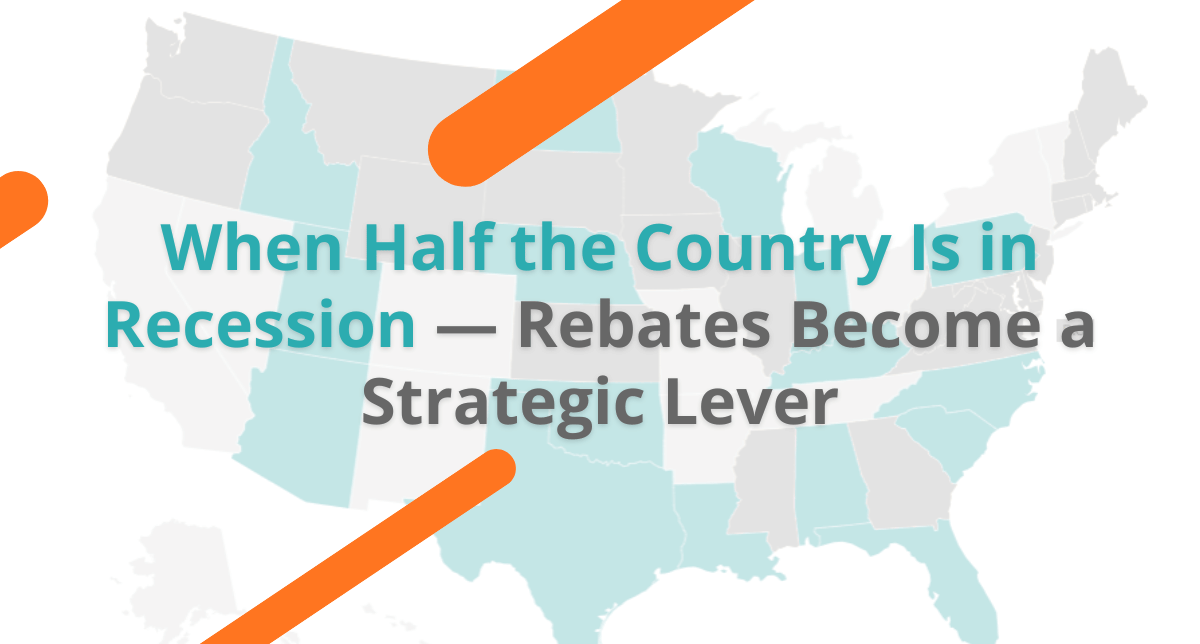
A recent analysis by Moody’s Chief Economist Mark Zandi estimates that 22 U.S. states (plus D.C.) are already in economic contraction, showing persistent job losses and weakness. (Source: MaketWatch) Another 13 states are “treading water,” hovering between growth and decline. (Source: MarketWatch)
That means nearly one-third of U.S. GDP is tied to states whose economies are under strain. (Source: AXIOS) In such a divided macro environment, brands must act with precision.
The Risk of Blind Discounts
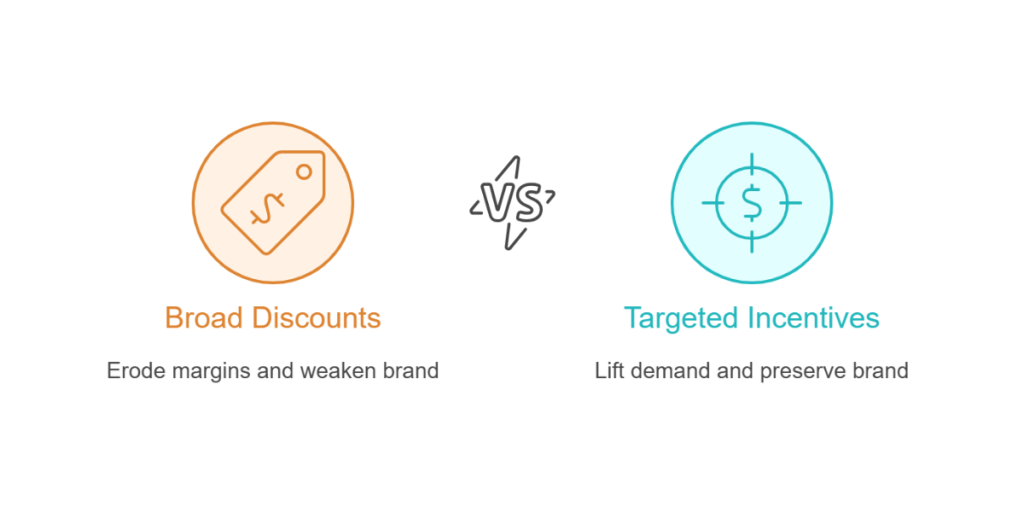
When the economy softens, many companies instinctively cut prices or offer broad discounts. The danger:
- You erode your margins where you didn’t need to.
- You train customers to expect discounts, which weakens their ability to withstand shocks.
- You blur brand value just when customers are most price-sensitive.
Instead of “spray and pray,” what if you could target incentives precisely, lifting demand where it’s most depressed, and leaving pricing intact where conditions hold up?
Why Rebates Make Sense (Especially Now)
- Localized stimulus, national control
Rebates let you target incentives to specific states, channels, or customer segments. If State A is in recession and State B is not, you can layer a rebate only in State A, helping local demand without hurting your revenue in State B. - Better cash flow, less erosion up front
Unlike upfront discounts, rebates let you collect full payment first, then pay out later. This helps your working capital while still offering real value to buyers. - Rich behavioral & market data
Rebate redemption gives you insights into which states responded, which product lines gained traction, and which partners moved inventory. Over time, you build a map of responsiveness by geography and customer type. - Positive framing & soft support
Instead of cutting prices (which can feel desperate), you can frame rebates as support, reward, or stimulus, especially meaningful in a downturn. That builds goodwill. - Flexibility & scalability
You can ramp rebates up, tone them down, or withdraw them entirely in a given geography faster and more surgically than by changing list prices.
How Incentive Insights Can Help Your Brand Pull This Off

At Incentive Insights, we can help you:
- Overlay recession maps on your sales territories
Use economic data to identify which states are under stress (like the 22 in contraction) and overlay that on your target markets. - Design tiered rebate offers
You might offer a “rebate [plus] bonus tier” where customers in recession states receive higher percentage rebates or extra units to incentivize movement. - Manage digital submission and payout
Fast, transparent, and easy to deploy are critical when your customers or channel partners are tight on cash. - Measure ROI by state, SKU, and channel
Compare pre- and post-lift performance in recession vs. non-recession states, and evaluate how rebates perform relative to other promotion types. - Iterate quickly across cycles
If one state recovers faster than expected, you can pull back rebates there. If another weakens further, you can lean in.
Sample Scenario
Imagine you sell an industrial component. You notice that State X (in recession) is trailing by 20% year-over-year, while State Y (outside recession) is flat.
- You introduce a 5% rebate + bonus-tier incentive only in State X.
- In State Y, you keep your standard margin structure, perhaps offering a mild “loyalty rebate” instead.
- Over 3 months, you track redemption, order lift, partner movement, and incremental margin.
- If State X rebounds, you scale back the rebate; if State Z starts slipping, you expand the program there.
While it seems like a simple step to drive revenue in these challenging times, as with anything, you need to understand a few potential pitfalls.
Key Considerations & Cautions
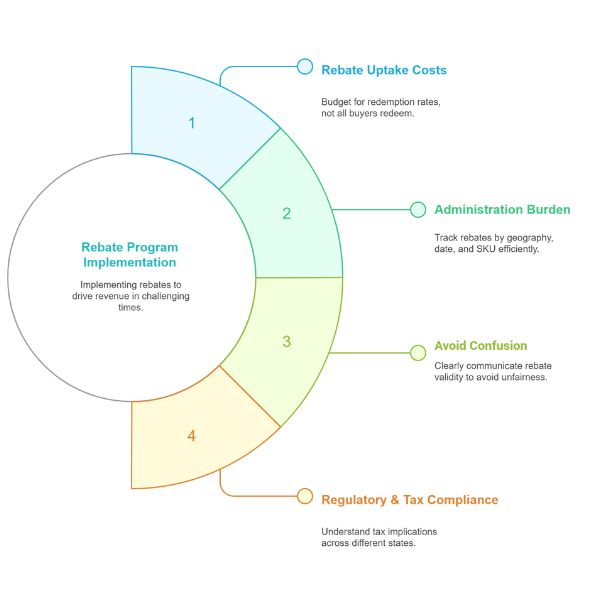
- Rebate uptake costs: You’ll need to budget for redemption rates. Historically, not all eligible buyers redeem.
- Administration burden: Ensure your systems can track by geography, date, and SKU.
- Avoid confusion: Be clear in your messaging: “Rebate valid in select states.” You do this to avoid perceptions of unfairness.
- Regulatory & tax compliance: Ensure you understand how rebates are taxed or treated in different states.
Final Thought
In a split-cycle economy, where nearly half the country is under recessionary stress, your promotional toolkit must get smarter. Rebates are one of the few levers that let you be both generous and disciplined.
You can inject growth where it’s needed, preserve margins where you can, and gather the insights to outmaneuver your competitors.
If you’d like help drafting a rebate-strategy playbook for your industry or a specific region, we’d be happy to help. Get started HERE.

Nathaniel Smathers, a contributor to the Incentive Insights blog, brings a fresh perspective on business strategies and market trends. With a background in marketing and a passion for data-driven insights, Nathaniel offers a unique blend of expertise and creativity. His approach to dissecting complex market dynamics and transforming them into actionable strategies makes him an invaluable asset to our team.