Everyone loves a good deal… until the “deal” ends up costing more than the premium option you passed on.
Rebate fulfillment and check processing are no different.
From the outside, a low-cost provider or DIY, in-house check cutting seems like a money saver. After all, how hard can it be to issue checks, track payouts, and manage a simple rebate workflow?
Ask any controller or accounting manager, and you’ll get a knowing smile.
Because the truth is simple: Cheap solutions aren’t really cheap. They shift the cost onto you in terms of time, risk, and administrative headaches, which should make finance managers feel cautious about low-cost options.
Before you choose the lowest bidder or continue to handle checks in-house, it’s worth understanding what you actually get… and what you absolutely don’t.
What a Budget Solution Really Includes (Spoiler: Not Much)
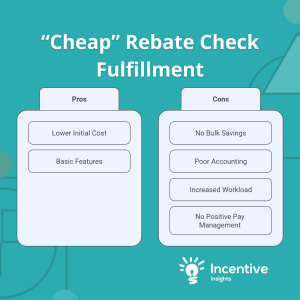
When you peel back the layers of a budget rebate or check‑fulfillment provider, you typically find the same handful of bare‑minimum features: basic check printing, slow processing timelines, and limited communication. It’s just enough to call the service “functional technically,” but nowhere near sufficient to support a finance department that values accuracy, speed, and transparency.
Most low‑cost providers rely heavily on manual steps. That means your team ends up doing the administrative heavy lifting: gathering payout data, formatting spreadsheets, handling exceptions, and troubleshooting errors long after the checks have gone out. And because these providers don’t negotiate bulk rates, every fee hits your budget at full retail price. What looked affordable upfront quickly becomes a patchwork of unexpected charges.
Even worse, budget solutions often skip fraud protection, bank reconciliation, and compliance measures. You’ll get access to Positive Pay, but not help managing it, which turns what should be a safeguard into yet another task for your accounting team.
A quick example: A mid‑sized manufacturer tried cutting rebate checks in‑house to “save money.” By the end of Q1, their controller had spent nearly 30 hours per week formatting submissions, reissuing checks that had been lost in the mail, and manually handling bank exceptions. Every check incurs full retail pricing plus postage, and a single mismatched Positive Pay record can cause a fraud hold that takes days to resolve; this can happen daily! What looked like the cheapest option ended up costing them more in labor hours and operational disruption than a full‑service provider would have charged for the entire rebate program (Click here for more about how to set up a rebate program).
Budget solutions may look simple, but they leave your team carrying the complexity.
What You Won’t Get With a Cheap Provider, and Why It Matters
When you choose a bargain provider, you’re not just paying for fewer features; you’re absorbing the high risks those missing features were designed to prevent.
- Bulk fee savings? Not happening. Low-cost vendors typically process checks at full retail bank pricing. Without negotiated rates, every transaction chips away at your budget. What should be a cost-efficient process becomes an expensive pay‑as‑you‑go model. If you got this far and are not doing checks, well then, there are prepaid cards. Click here to learn more about rebate prepaid cards.
- Accounting safeguards? You’re on your own. Cheap solutions rarely provide the financial oversight needed for clean reconciliation, and reissuing checks can be challenging. Missing data, misaligned payouts, and address errors come back to your team and often at the worst time, like month-end.
- Time savings? The opposite. Many companies don’t realize that cheap providers push the administrative work back onto internal teams. What could be automated or managed externally becomes hours of manual effort for your controller each week.
- And finally, the big one:
- Positive Pay vs. Positive Pay Management. Most providers will give you access to Positive Pay, a banking tool that verifies issued checks. But managing Positive Pay is the real work: uploading files, reviewing exceptions, correcting mismatches, and resolving daily discrepancies. Cheap vendors stop at access. Incentive Insights takes responsibility for the entire process.
The result? Less risk, fewer errors, and a dramatically lighter workload for your accounting team.
What You Do Get With a Full-Service Partner Like Incentive Insights
With a full‑service partner, the experience shifts from “doing everything yourself” to having an operational engine behind your rebate and check programs. Instead of piecing together tasks, managing exceptions, or juggling unanswered questions, you gain a structured, secure, and predictable workflow that actually saves time and money.
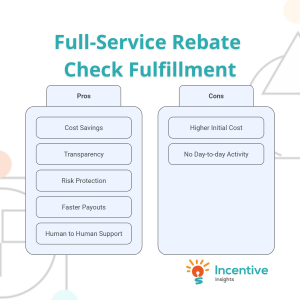
- Zero-Balance Account & bulk pricing that work for you. Clients’ funds into ZBA. ( zero balance account where funds are swept into it daily to cover the daily checks presented and approved for payment through positive pay). If any corporation were to add this for internal use, you would spend thousands. Also, Incentive Insights can negotiate significantly better check‑processing rates. This isn’t a small perk; it’s often the difference between paying retail fees for every single check versus enjoying pricing that scales with your program. The more volume you process, the more you save.
- Transparent fees without the nickel‑and‑diming. Unlike low‑cost vendors that hide charges behind postage, reissues, exceptions, and administrative add‑ons, a full‑service model gives you complete visibility into what you’re paying for. No surprises. No back‑end fees. No “gotchas” that show up on the monthly ledger.
- Built‑in risk protection. Lost checks, fraud attempts, and bank exceptions aren’t just hypothetical. A full‑service provider assumes that risk, not you. Your payouts are insured, your financial exposure is minimized, and your recipients get what they’re owed without unnecessary delays.
- Faster payouts that reinforce trust. Whether you’re running consumer rebates or B2B incentives, speed matters. Incentive Insights’ streamlined workflows enable Quick payments, which should reassure decision-makers about the reliability and credibility of their partners.
- Real support for controllers and accounting teams. Instead of spending hours each day formatting files, uploading exceptions, or reissuing checks, your team gets its time back. This should make your team feel confident that choosing full-service options can ease their workload and improve accuracy.
Real Cost Comparison: Cheap vs. Quality
Below is a simple snapshot showing how the true cost of a “cheap” solution compares with that of a full‑service provider. The dollar amounts and time estimates vary by company. Still, the pattern is the same: what looks cheaper upfront often becomes the most expensive option when you factor in real workload, risk, and operational drag.
Below is a simple snapshot showing how the true cost of a “cheap” solution compares with that of a full‑service provider. The dollar amounts and time estimates vary by company. Still, the pattern is the same: what looks cheaper upfront often becomes the most expensive option when you factor in real workload, risk, and operational drag.
| Category | Cheap / Budget Provider | In‑House (DIY) | Incentive Insights Full‑Service |
|---|---|---|---|
| Cost Per Check | Full retail pricing; no discounts | Full retail pricing + postage | Bulk‑rate pricing through relationships with banks |
| Administrative Time | 10–25 hours/week | 20–40 hours/week | 1–3 hours/week (review only) |
| Fraud Protection | Basic Positive Pay access only | Must manage Positive Pay manually | Full Positive Pay Management + Fraud Protection |
| Error Handling | Client resolves errors | Client resolves errors | INIS manages corrections and reissues |
| Hidden Fees | Common (postage, reissues, exceptions) | High (labor, postage, bank charges) | Minimal; transparent pricing |
| Overall Cost (Direct + Indirect) | Medium → High | High | Low → Medium (with far greater protection and time savings) |
When companies run the math honestly, they almost always reach the same conclusion: the lowest sticker price is rarely the lowest total cost. The real expense comes from your team’s time, the risk you assume, and the inefficiencies that compound month after month.
Why Time Savings Alone Make the Difference
When finance teams talk about being stretched thin, check fulfillment is almost always part of the reason, even though no one realizes just how time‑consuming it is until they finally stop doing it themselves. Cutting checks isn’t just printing paper and dropping envelopes in the mail. It’s verifying data, checking totals, formatting files, reviewing exceptions, reissuing payments, tracking what cleared, and making sure everything lines up at reconciliation.
For most organizations, that adds up quickly. Controllers regularly report losing 10–40 hours each week to the administrative swirl surrounding payouts. That’s not an exaggeration; that’s the lived reality for companies handling even moderate rebate or incentive volumes.
And here’s the part most people don’t calculate: those hours come from your highest‑value employees. Time spent troubleshooting Positive Pay exceptions or chasing down undeliverable checks is time not spent on forecasting, budgeting, cash‑flow planning, or the strategic work only your finance team can do.
By contrast, shifting check fulfillment to Incentive Insights reduces the workload associated with issuing payments by roughly 90%. Your team reviews and approves, you don’t manage the mechanics. It’s the difference between carrying the weight of the process and simply steering it. When time is your most limited resource, reclaiming even five hours a week can reshape your capacity. Reclaiming twenty or more? That can change the trajectory of your entire department.
And before we conclude, there’s one more piece that budget providers almost never mention — kitting. Incentive Insights can print your custom (non‑personalized) documents, match them with the corresponding check, and mail them together as a complete, professional packet. This is especially valuable when recipients need context, such as:
- Sales incentive letters explaining which promo or product the payment is tied to
- Legal notices clarifying that funds are not taxable to the recipient
- Sunshine Law (Open Payments) compliance letters are required in states like Florida
Kitting ensures every check arrives with the correct supporting documentation, without confusion, extra handling, or mismatched materials. Budget providers either skip this entirely or require manual, time‑consuming personalization work. With Incentive Insights, it’s built into the workflow, reducing costs, eliminating errors, and creating a seamless recipient experience.
Conclusion
When you step back and look at the whole picture, the pattern is clear: cheap solutions don’t actually save you money; they shift the cost to different parts of your organization. Whether it’s higher bank fees, lost time, increased fraud exposure, or the strain placed on your accounting team, the trade-offs compound quickly. What looks like a budget-friendly option becomes the most expensive choice once you account for everything it adds to your workload.
The good news? You don’t have to keep operating that way. With a full-service partner like Incentive Insights, you gain a system that simplifies payouts, reduces risk, and gives your team back the time they need for the strategic work that drives growth.
If you’re ready to reduce operational drag and move away from manual check fulfillment, here are a few practical next steps:
- Audit your current process. Document how many hours per week your team spends on payout administration and reconciliation. You’ll likely be surprised.
- Calculate your actual cost per check. Include bank fees, postage, labor hours, and the cost of reissues—not just the face value of the payment.
- Assess your fraud protection. Determine whether you’re simply accessing Positive Pay or actively managing it. The gap matters.
- Talk with our team. We can walk you through how a full-service model works, what efficiencies you can expect, and how escrow pricing can immediately reduce your per-check costs.
The goal isn’t just to save money. It’s to create a process that finally works the way it should: smoothly, securely, and without pulling your team away from the work that matters most.
👉 Let us handle your rebate check fulfillment.

Nathaniel Smathers, a contributor to the Incentive Insights blog, brings a fresh perspective on business strategies and market trends. With a background in marketing and a passion for data-driven insights, Nathaniel offers a unique blend of expertise and creativity. His approach to dissecting complex market dynamics and transforming them into actionable strategies makes him an invaluable asset to our team.