Have you ever noticed the numerous discounts available on some of your favorite e-commerce sites? Discounts are everywhere. But what if you could drive sales without eroding your price perception? That’s where rebate programs come in.
Rebates reward customers after purchase, usually once they submit proof of their order, rather than lowering the price upfront. Unlike discounts, which change how your product is perceived, rebates can help you maintain full retail value while still giving shoppers a reason to buy now. So, there are rebates not just for cars, appliances, or large bulk orders from a national B2b manufacturer.
In this guide, we’ll explore how Shopify sellers can plan, launch, and manage a successful rebate marketing program: from structure and setup to automation and optimization.
Why Use Rebates on Shopify
Rebates are a secret weapon for Shopify merchants seeking to strike a balance between growth and profitability. Here’s why:
- Preserve perceived value.
Customers pay the full listed price, reinforcing your brand’s worth. The rebate acts as a reward, not a markdown. This approach helps your products maintain their perceived premium quality in the market. It also reassures repeat customers that your pricing remains consistent, even when promotional incentives are active. - Encourage higher-value orders.
Tiered or spend-based rebates (“Spend $100, get $20 back”) naturally increase average order value and boost upsells. This encourages customers to add that extra item to meet the rebate threshold, improving cart totals. It also motivates return buyers to plan larger purchases over time, knowing they’ll receive more value for their investment. (“Spend $100, get $20 back”) naturally increase average order value and boost upsells. - Capture valuable customer data.
Each redemption provides you with direct customer information, purchase behavior, contact info, and feedback for future marketing purposes. This consumer data provides you with deeper insight into who your most engaged customers are and what motivates them to make a purchase. By analyzing this information, you can tailor your promotions, improve your targeting, and strengthen long-term customer relationships. - Benefit from “breakage,” ethically.
Not everyone redeems their rebate, which can improve ROI. However, transparency and fairness are key, and rebates should enhance trust rather than exploit confusion. When managed responsibly, breakage can offset administrative costs, making the program sustainable. It’s crucial to clearly communicate deadlines and redemption steps so customers understand the process, ensuring your rebate strategy builds goodwill rather than skepticism.
Planning Your Rebate Program
Before launching, map out the fundamentals. A well-structured rebate plan keeps your program compliant, trackable, and customer-friendly.
Set Clear Goals
Decide what success looks like. Examples include:
- Boosting average order value by 20%
- Driving repeat purchases from first-time buyers
- Growing email list sign-ups through rebate redemptions
Choose the Right Rebate Structure
There’s no one-size-fits-all model. Common approaches include:
- Flat amount: “Get $10 back on any order.”
- Percentage rebate: “Receive 10% back on your total purchase.”
- Tiered rebates: “Spend $50, get $5. Spend $150, get $20.”
- Conditional rebates: “Buy X, get Y back” (e.g., purchase one item from each collection).
Define Eligibility Rules & Timeframes
Set parameters around:
- Eligible SKUs or product categories
- Purchase dates and redemption deadlines
- Minimum order value
- Proof-of-purchase requirements
Select Payout Methods
Options range from store/site credit and digital gift cards to prepaid cards or direct transfers. Many merchants prefer digital fulfillment for speed and security.
Plan Verification & Redemption Workflows
Redemption should be fraud-resistant but straightforward. Typically:
- Buyer submits a form with their order number and proof of purchase.
- Data is validated against your Shopify records.
- Payouts are issued automatically or through a trusted partner, such as Incentive Insights.
The more steps you can automate, the smoother the customer experience will be and the less manual work your team will have to do.
Executing on Shopify
Running a rebate program through Shopify can be done with the right mix of apps, workflows, and partner tools.
Implement Rebate Logic
Shopify’s app ecosystem includes rebate-friendly tools that allow for:
- Conditional discounts (post-purchase)
- Customer tagging and data exports
- Automated gift card creation or payout tracking
Alternatively, you can use custom scripts or third-party platforms to manage verification and fulfillment outside Shopify, then sync the results back via exports or APIs. Note* Custom development may not be the best place to start, so we recommend you try to build the process manually or use someone like us 😉 To help with the fulfillment. More on this below. 👇
Use Automation Wisely
Full system integrations can be expensive and time-consuming. Many merchants start with a “return logic” workflow:
- Export purchase data from Shopify.
- Share securely with a rebate processing partner.
- Partner validates claims and issues payouts digitally.
This approach allows you to test a program quickly without committing to full API integration. Incentive Insights, for example, helps Shopify sellers handle this off-platform, automating review, verification, and digital reward fulfillment seamlessly.
Promote Your Rebate
Visibility drives redemptions and repeat sales. Announce your offer:
- On product and checkout pages
- Through Shopify email campaigns
- In social media ads and banners
Always frame the benefit in dollar terms (“Get $25 back”) rather than percentages, which feel less tangible.
Track Redemptions and Fraud
Monitor claim rates, redemption velocity, and potential abuse (e.g., duplicate claims). Data transparency helps you adjust thresholds or tighten rules as needed.
Shopify’s Own Example: The Merchant Rebate Program
Even Shopify uses rebates internally. Its Sales Rebate Promotion offers merchants a 1% rebate on eligible gross sales, deposited into their Shopify Balance account. Refunds and chargebacks reduce subsequent payouts, underscoring a crucial operational truth: rebates are only as substantial as your accounting and verification systems.
Shopify’s own example validates the model: rebates work best when automated, predictable, and tied to transparent metrics.
Common Pitfalls (and How to Avoid Them)
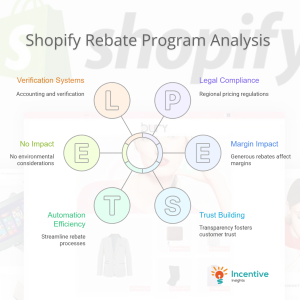
- Complicated Redemption Process – Long forms or tight deadlines cause drop-offs. Keep submission steps under two minutes.
- Lack of Transparency – Always clearly list terms, deadlines, and payout details. Hidden fine print kills trust.
- Delayed Payouts – Customers expect fast fulfillment. Aim to issue within 10 business days of validation.
- Poor Data Tracking – Without monitoring redemption and breakage rates, you’ll struggle to measure ROI.
- Legal Risks – Ensure your advertised “after-rebate” prices comply with regional laws.
- Over-promising – Don’t offer rebates so generous they hurt your margins. Start small, test, then scale.
- Premature Integration – Avoid building complex integrations before you’ve tested the concept. Pilot programs first.
And always verify returns before issuing payouts—rebates shouldn’t be issued for refunded orders.
Measuring Success and Refining Your Offer
A rebate campaign isn’t “set and forget.” Continuous measurement keeps it profitable and relevant.
Track metrics such as:
- Redemption rate (submissions ÷ total eligible purchases)
- Lift in average order value (AOV)
- ROI per campaign
- Repeat purchase rate post-rebate
Run A/B tests with different rebate levels or eligibility rules. Collect feedback from participants—ask how easy the process was and whether it influenced their purchase. Use this data to refine thresholds, deadlines, and payout methods for future campaigns.
Example Workflow: A Toy Brand Scenario
Imagine a Shopify toy retailer launching a rebate: “Buy $100+, get $20 back.”
- The customer shops full price on your site.
- After checkout, they receive an email link to a rebate form.
- They upload proof of purchase.
- Incentive Insights’ system validates the claim and issues a $20 digital gift card.
- Data from redemptions flows back to the brand to track engagement and ROI.
With this setup, the merchant never has to handle payout logistics—and customers enjoy a seamless experience.
Conclusion: Turn Rebates into Revenue Drivers
Rebates can be used to generate revenue in two profound ways. It preserved margins and increased conversions when built thoughtfully.
Start small, automate where possible, and always make redemption effortless. Once you find your winning formula, rebates can become a long-term growth lever that fuels loyalty and repeat business.
If you’re ready to explore a Shopify rebate strategy that’s data-driven and fully managed, Incentive Insights can help. From planning and fulfillment to fraud prevention and reporting, we simplify every step, allowing you to focus on selling.
👉 Let’s build your next rebate program together.

Nathaniel Smathers, a contributor to the Incentive Insights blog, brings a fresh perspective on business strategies and market trends. With a background in marketing and a passion for data-driven insights, Nathaniel offers a unique blend of expertise and creativity. His approach to dissecting complex market dynamics and transforming them into actionable strategies makes him an invaluable asset to our team.