Introduction
As a manufacturer, you likely sit at the top of your sales channel. From up there, it can be challenging to see, let alone control, what’s happening with your wholesalers, retailers, and customers below. While this may be true for many manufacturers, you cannot let this affect your bottom line.
As a manufacturer, which aspects of your sales channel are performing well, underperforming, or need some strategic support? Many times, taking steps to incentivize various key players in your sales channel and your end customers can make all the difference when it comes to driving monthly, quarterly, or yearly sales.
3 Steps Manufacturers Can Take To Build Demand With Strategic B2B or B2C Channel Incentives
Below, we’ve listed three steps to help you get going in the demand-building direction.

STEP 1: INCENTIVIZE RETAILERS TO PURCHASE AND STOCK YOUR PRODUCT WITH A B2B REBATE
As a manufacturer, you can incentivize retailers to purchase your product from you or one of your wholesalers and stock it in their store for consumers to buy.
When costs increase, whether due to inflation, supply chain issues, or tariffs, incentives can offer a buffer. By reducing the effective price or adding value to the purchase, brands can ease the pain for both partners and end consumers.
Research in the area of incentive contracts and supply chain management has shown that well‑designed rebate programs can improve the alignment between manufacturers and their distributors or retailers. Studies in this field, such as those by Cachon and Lariviere on supply chain contracts, demonstrate that these incentives help manage cost pressures and encourage higher volume purchases. While not focused exclusively on tariffs, the mechanism is the same: lowering the effective cost through rebates enables companies to absorb more increased expenses, passing less of the burden to the end consumer. This strategy ultimately helps preserve demand, even when external pressures rise.
During this step, you also have the opportunity to learn more about your wholesalers and retailers. It can sometimes be difficult as a manufacturer to get to know every member of your sales channel, but it can help you improve your overall strategy.
Consider your specific sales goals when determining which type of rebate to use, as each has its purpose.
COMMON TYPES OF MANUFACTURER TO RETAILER (B2B) REBATES
Product launch rebates: Encourage the stocking of new products.
When introducing a new product, link spending on it to discounts on regular purchases with a product launch rebate.
Volume rebates: Discounts based on purchase volume.
Offer your buyers a discounted price per unit when they purchase a specific number or volume of units. For example, “buy 1-100 units for $100 per unit, 101-500 units for $97 per unit, and so on…”. This will encourage your B2B customers to purchase more of your product for a better price.
Growth rebates: Rewards for incremental growth.
A rebate that rewards your B2B customers based on incremental order growth. Like volume rebates, growth rebates are paid on incremental growth, whereas volume rebates are paid on all revenue or total volume. “Sell the solution not the product“
End-of-life rebates: Clear outdated inventory.
Offer your B2B customers an incentive to purchase an older or outdated version of your product to prepare your warehouse for a newer, more up-to-date product on the way.
Product mix rebate: Promote a diverse product range.
Encourage your B2B customers who tend only to purchase and stock a few (or the same) of your products to buy and stock a variety of your other products with a product mix rebate.
Retention rebate: Reward loyal customers.
A retention rebate should be offered to your loyal B2B customers, encouraging business continuity.
INFORMATION COLLECTIBLE VIA B2B REBATE
As previously mentioned, a B2B rebate is an opportunity to learn about your sales channel partners, especially your retailers, with whom you might not otherwise be connected.
Tie your B2B rebate to a survey or psychographic questions about:
- The customer (retailer) themselves (EIN, address, phone number, etc.)
- The wholesaler or distributor, your customer, purchased your product from
- The specific WD (wholesaler/distributor) salesperson the retailer purchased your product from and who serviced their account
- If your customer was offered anything from their WD with their purchase (better credit terms, discounts off MSRP, free shipping, etc.)
From here, you can determine how to use this information to your advantage, whether tailoring a future incentive or improving your overall marketing and sales strategy–the possibilities are enormous!
New Insights for 2025:
Recent studies show that companies using targeted B2B rebates saw a 20% increase in retailer engagement and a 15% boost in sales volume compared to non-incentivized periods.
STEP 2: INCENTIVIZE MEMBERS OF YOUR SALES CHANNEL WITH A SPIF
A SPIF (Sales Program Incentive Funds) is an incentive program you can offer as a manufacturer to motivate your retail channel partners to increase product sales. Through a SPIF, your retailers can earn rewards when their salespeople sell “X” number of dollars (or units) towards a specific sales goal or campaign.
A SPIF can be an effective way to get the attention and focus of your retailer’s sales team on your product. By offering an SPIF, you’ll likely see sales take off,
OFFER A SPIF IF….
- A new product is hitting the market, and you want it to be adequately introduced to the public
- A specific product is not selling well and could use a little extra push
- Old inventory needs to be cleared from shelves (expiring or outdated products)
- You need to increase profit or drive short or long-term sales
GAIN LOYAL AND KNOWLEDGEABLE SALES PARTNERS WITH SPIFS
SPIFs benefit everyone involved. Your sales partner receives a reward for their hard work, and you gain a base of quality, loyal, and knowledgeable salespeople.
With a list of sales representatives who participated in your offer, you can accurately target the people responsible for selling your product with information that will allow you to continue selling your product–and sell it better!
Consider that, at some point, that sales partner will have to decide to repurchase. This decision will be a no-brainer if they see the value in your incentive and you make selling your product easy!
Read more about how a SPIF can generate sales for your business.
Updated Strategy for 2025:
In 2025, incorporating digital SPIF platforms has led to a 25% increase in sales team participation and a 30% improvement in sales performance, as digital tracking and instant rewards make these programs more appealing and efficient.
STEP 3: INCENTIVIZE CONSUMER PURCHASE WITH B2C REBATES
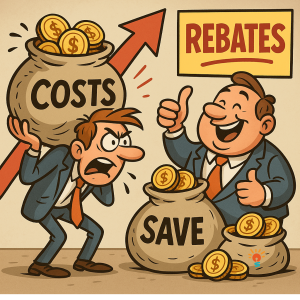
Sometimes, more than steps one and two are needed to drive the demand your company seeks. After all, there are only so many retailers and salespeople who can sell your product. That’s where step three comes in–B2C rebates.
A consumer rebate can help you reach many of your business’s sales goals, from driving short—and long-term sales to gaining market share and breaking into new markets.
One of the most significant benefits of a B2C rebate is the ability to collect high-quality customer data. This data can be used to personalize customer journeys, target personalized marketing messages, and more! We discuss how to make consumer rebates work for your company here.
Critical Updates for 2025:
A recent survey found that 60% of consumers are more likely to purchase from brands offering rebates, and 40% prefer digital rebates due to ease of use and faster processing times.
THE HYBRID INCENTIVE APPROACH PROVES THE MOST EFFECTIVE
For manufacturers trying to hit serious sales numbers, we recommend combining all three steps–B2B rebates, SPIFs, and B2C rebates.
- Step one: Get your product in the store.
- Step two encourages sales partners to reach specific sales goals without a product discount.
- Step three helps your partners clear out leftover inventory and encourages your end customers to purchase.
There is major data collection potential at each step. Remember that when planning your incentives, you should think strategically.
Because we believe in this approach and understand that your needs will differ from those of other companies, we offer flexible incentive program solutions. Together, we can determine your needs and how an incentive or mix of incentives can help you reach your goals.
Conclusion
Updating incentive strategies with the latest trends and technologies can significantly enhance demand-building efforts. For tailored solutions, explore Incentive Insights’s available incentive programs to meet your business goals in 2025 and beyond.

Nathaniel Smathers, a contributor to the Incentive Insights blog, brings a fresh perspective on business strategies and market trends. With a background in marketing and a passion for data-driven insights, Nathaniel offers a unique blend of expertise and creativity. His approach to dissecting complex market dynamics and transforming them into actionable strategies makes him an invaluable asset to our team.